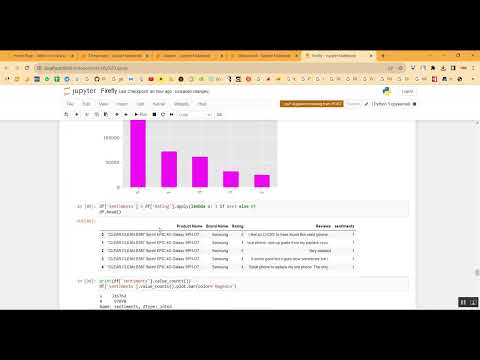
AI & ML Models
0.0 (0 reviews) • 0 downloads
Amazon Review in Python Projects
र 1000
Amazon Review in Python Projects
Technical Details
Domain : Python
Database : Sqlite
Tools : Anaconda
Run Tools: VS Code
Database : Sqlite
Tools : Anaconda
Run Tools: VS Code
Secure Payment
Instant Download
GST Invoice
24/7 Support
About This Product
Amazon Review in Python Projects
Abstract
Customer reviews play a vital role in shaping purchasing decisions on e-commerce platforms like Amazon. With millions of reviews available, manual analysis becomes difficult, making it challenging for customers to identify genuine feedback and for sellers to understand customer sentiment effectively. This project, Amazon Review Analysis in Python, focuses on building an intelligent system to analyze product reviews using Natural Language Processing (NLP) and Machine Learning techniques. The system processes Amazon reviews to perform sentiment classification (positive, neutral, or negative) and can also identify key features mentioned in customer feedback. Python libraries such as Pandas, Scikit-learn, NLTK, spaCy, and TensorFlow/Keras are used to preprocess text, extract features, and train models for sentiment analysis. This automated approach helps customers make informed decisions and enables businesses to improve products and services based on customer opinions.
Existing System
Currently, users rely on manually reading Amazon reviews to evaluate product quality. While Amazon provides star ratings, they often fail to reflect the true sentiment of written reviews, as ratings can be misleading or inconsistent with the review text. Some existing review analysis systems use simple keyword-based methods or rule-based sentiment analysis, which lack contextual understanding and often produce inaccurate results. Additionally, fake or spam reviews further reduce the reliability of manual review evaluation. As a result, the existing systems are not scalable or intelligent enough to handle large volumes of unstructured textual data effectively.
Proposed System
The proposed system introduces a Python-based Amazon review analysis model that uses NLP and machine learning/deep learning to classify sentiments and summarize opinions. The system preprocesses reviews by removing stop words, punctuation, and applying tokenization, lemmatization, and TF-IDF or word embeddings. These processed features are then fed into machine learning classifiers (Logistic Regression, SVM, Random Forest) or deep learning models (CNN, LSTM) to predict whether a review is positive, negative, or neutral. The system can also integrate fake review detection techniques by identifying unusual review patterns or repetitive content. A user-friendly interface (possibly built with Flask/Streamlit) allows visualization of sentiment trends, word clouds, and product insights. This approach improves upon existing systems by offering automation, scalability, and higher accuracy in understanding customer feedback.
Abstract
Customer reviews play a vital role in shaping purchasing decisions on e-commerce platforms like Amazon. With millions of reviews available, manual analysis becomes difficult, making it challenging for customers to identify genuine feedback and for sellers to understand customer sentiment effectively. This project, Amazon Review Analysis in Python, focuses on building an intelligent system to analyze product reviews using Natural Language Processing (NLP) and Machine Learning techniques. The system processes Amazon reviews to perform sentiment classification (positive, neutral, or negative) and can also identify key features mentioned in customer feedback. Python libraries such as Pandas, Scikit-learn, NLTK, spaCy, and TensorFlow/Keras are used to preprocess text, extract features, and train models for sentiment analysis. This automated approach helps customers make informed decisions and enables businesses to improve products and services based on customer opinions.
Existing System
Currently, users rely on manually reading Amazon reviews to evaluate product quality. While Amazon provides star ratings, they often fail to reflect the true sentiment of written reviews, as ratings can be misleading or inconsistent with the review text. Some existing review analysis systems use simple keyword-based methods or rule-based sentiment analysis, which lack contextual understanding and often produce inaccurate results. Additionally, fake or spam reviews further reduce the reliability of manual review evaluation. As a result, the existing systems are not scalable or intelligent enough to handle large volumes of unstructured textual data effectively.
Proposed System
The proposed system introduces a Python-based Amazon review analysis model that uses NLP and machine learning/deep learning to classify sentiments and summarize opinions. The system preprocesses reviews by removing stop words, punctuation, and applying tokenization, lemmatization, and TF-IDF or word embeddings. These processed features are then fed into machine learning classifiers (Logistic Regression, SVM, Random Forest) or deep learning models (CNN, LSTM) to predict whether a review is positive, negative, or neutral. The system can also integrate fake review detection techniques by identifying unusual review patterns or repetitive content. A user-friendly interface (possibly built with Flask/Streamlit) allows visualization of sentiment trends, word clouds, and product insights. This approach improves upon existing systems by offering automation, scalability, and higher accuracy in understanding customer feedback.
Customer Reviews (0)
No reviews yet. Be the first!
Related Products
⭐ Featured
AI & ML Models
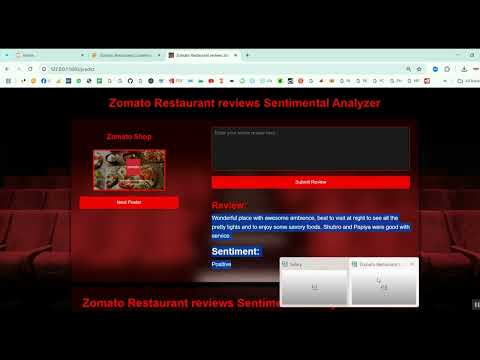
Zomato Restaurant Reviews Sentimental Analyzer in Python Projects
Zomato Restaurant Reviews Sentimental Analyzer in Python Projects
र 1000
⭐ Featured
⭐ Featured

AI & ML Models
Voice Disorder Prediction using Audio Dataset in Python Projects
Voice Disorder Prediction using Audio Dataset in Python Projects
र 1000

AI & ML Models
Vitamin Deficiency Detection Using Image Processing in Python Projects
Vitamin Deficiency Detection Using Image Processing in Python Projects
र 1000