NS2 Simulation
0.0 (0 reviews) • 0 downloads
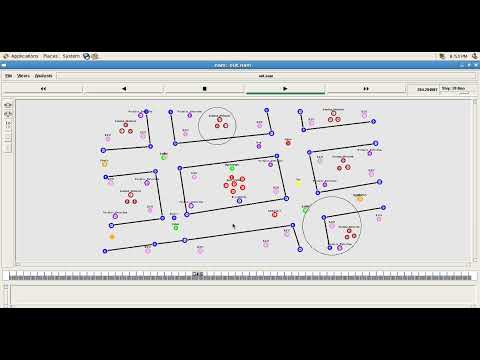
A novelty of Hypergraph Clustering Model (HGCM) for Urban Scenario in VANET
र 1000
A novelty of Hypergraph Clustering Model (HGCM) for Urban Scenario in VANET
Technical Details
Domain : NS2 Simulation
OS : CentOS Linux
Tools : VM Ware Workstation
OS : CentOS Linux
Tools : VM Ware Workstation
Secure Payment
Instant Download
GST Invoice
24/7 Support
About This Product
A novelty of Hypergraph Clustering Model (HGCM) for Urban Scenario in VANET
Abstract
Vehicular Ad Hoc Networks (VANETs) in urban scenarios face unique challenges such as high node density, dynamic topology, signal interference from tall buildings, and frequent handovers at intersections. Conventional graph-based clustering models often oversimplify relationships between vehicles by considering only pairwise connections, which can lead to unstable clusters and inefficient routing. This paper introduces a Hypergraph Clustering Model (HGCM) as a novel approach to capture higher-order relationships among vehicles and roadside units (RSUs). By representing multiple vehicles and RSUs within a single hyperedge, HGCM can model group-based mobility, shared routes, and collective behaviors more effectively than traditional graphs. The model improves cluster stability, reduces cluster-head switching, and enhances routing efficiency and quality of service (QoS) for safety and infotainment applications in urban VANETs.
Existing System
Current VANET clustering techniques—such as Lowest-ID, Highest-Degree, Mobility-based clustering, or traditional graph-based models—assume static or slowly varying topologies and rely on pairwise links between vehicles. While these methods work reasonably well in highway environments, they struggle in dense urban areas where multiple vehicles interact simultaneously and road layouts create highly dynamic connectivity patterns. Existing clustering suffers from frequent cluster head changes, high control overhead, and unstable clusters due to rapid speed variations and intersection dynamics. Moreover, traditional graph models cannot naturally express group-level mobility or many-to-many relationships, resulting in poor predictive capability for routing and resource allocation. This lack of higher-order modeling limits the ability to optimize QoS and maintain reliable communication in real-world city conditions.
Proposed System
The proposed Hypergraph Clustering Model (HGCM) extends the conventional graph representation to a hypergraph structure where hyperedges connect multiple vehicles and RSUs simultaneously, capturing shared mobility patterns, common routes, or cooperative behaviors. Vehicles are grouped into hyperedges based on similarity metrics such as trajectory overlap, relative speed, and signal strength. A hypergraph-based clustering algorithm then identifies stable clusters and elects cluster heads considering higher-order connectivity rather than just pairwise links. This approach reduces cluster reconfigurations, minimizes control signaling, and improves routing decisions. HGCM also supports predictive clustering by analyzing evolving hyperedges over time, enabling pre-emptive cluster maintenance as vehicles approach intersections or high-mobility zones. Combined, these innovations lead to more reliable communication, lower latency, and improved QoS in dense urban VANET scenarios. The model can be integrated with existing VANET routing protocols to enhance throughput and safety-critical message delivery without major changes to physical-layer standards.
Abstract
Vehicular Ad Hoc Networks (VANETs) in urban scenarios face unique challenges such as high node density, dynamic topology, signal interference from tall buildings, and frequent handovers at intersections. Conventional graph-based clustering models often oversimplify relationships between vehicles by considering only pairwise connections, which can lead to unstable clusters and inefficient routing. This paper introduces a Hypergraph Clustering Model (HGCM) as a novel approach to capture higher-order relationships among vehicles and roadside units (RSUs). By representing multiple vehicles and RSUs within a single hyperedge, HGCM can model group-based mobility, shared routes, and collective behaviors more effectively than traditional graphs. The model improves cluster stability, reduces cluster-head switching, and enhances routing efficiency and quality of service (QoS) for safety and infotainment applications in urban VANETs.
Existing System
Current VANET clustering techniques—such as Lowest-ID, Highest-Degree, Mobility-based clustering, or traditional graph-based models—assume static or slowly varying topologies and rely on pairwise links between vehicles. While these methods work reasonably well in highway environments, they struggle in dense urban areas where multiple vehicles interact simultaneously and road layouts create highly dynamic connectivity patterns. Existing clustering suffers from frequent cluster head changes, high control overhead, and unstable clusters due to rapid speed variations and intersection dynamics. Moreover, traditional graph models cannot naturally express group-level mobility or many-to-many relationships, resulting in poor predictive capability for routing and resource allocation. This lack of higher-order modeling limits the ability to optimize QoS and maintain reliable communication in real-world city conditions.
Proposed System
The proposed Hypergraph Clustering Model (HGCM) extends the conventional graph representation to a hypergraph structure where hyperedges connect multiple vehicles and RSUs simultaneously, capturing shared mobility patterns, common routes, or cooperative behaviors. Vehicles are grouped into hyperedges based on similarity metrics such as trajectory overlap, relative speed, and signal strength. A hypergraph-based clustering algorithm then identifies stable clusters and elects cluster heads considering higher-order connectivity rather than just pairwise links. This approach reduces cluster reconfigurations, minimizes control signaling, and improves routing decisions. HGCM also supports predictive clustering by analyzing evolving hyperedges over time, enabling pre-emptive cluster maintenance as vehicles approach intersections or high-mobility zones. Combined, these innovations lead to more reliable communication, lower latency, and improved QoS in dense urban VANET scenarios. The model can be integrated with existing VANET routing protocols to enhance throughput and safety-critical message delivery without major changes to physical-layer standards.
Customer Reviews (0)
No reviews yet. Be the first!
Related Products
⭐ Featured
NS2 Simulation
W-GeoR Weighted Geographical Routing for VANET's Health Monitoring Applications in Urban Traffic Networks
W-GeoR Weighted Geographical Routing for VANET's Health Monitoring Applications in Urban Traffic Networks
र 1000
⭐ Featured
NS2 Simulation
Reliability-Aware Multi-Objective Optimization-Based Routing Protocol for VANET
Reliability-Aware Multi-Objective Optimization-Based Routing Protocol for VANET
र 1000
⭐ Featured
NS2 Simulation
PSEBVC Provably Secure ECC and Biometric Based Authentication Framework Using Smartphone for Vehicular Cloud Environment
PSEBVC Provably Secure ECC and Biometric Based Authentication Framework Using Smartphone for Vehicular Cloud Environment
र 1000
⭐ Featured
NS2 Simulation
Notice of Removal An Improved Equal Hierarchical Cluster-Based Routing Protocol for EH-WSNs to Enhance Balanced Utilization of Harvested Energy
Notice of Removal An Improved Equal Hierarchical Cluster-Based Routing Protocol for EH-WSNs to Enhance Balanced Utilization of Harvested Energy
र 1000