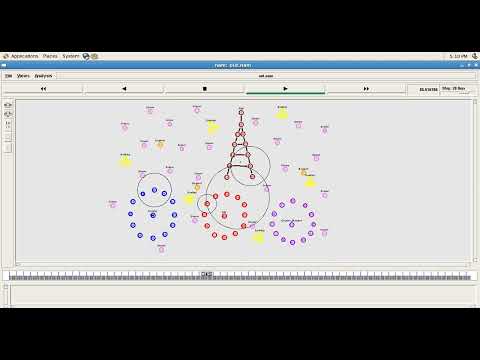
NS2 Simulation
0.0 (0 reviews) • 0 downloads
Notice of Removal An Improved Equal Hierarchical Cluster-Based Routing Protocol for EH-WSNs to Enhance Balanced Utilization of Harvested Energy
र 1000
Notice of Removal An Improved Equal Hierarchical Cluster-Based Routing Protocol for EH-WSNs to Enhance Balanced Utilization of Harvested Energy
Technical Details
Domain : NS2 Simulation
OS : CentOS Linux
Tools : VM Ware Workstation
OS : CentOS Linux
Tools : VM Ware Workstation
Secure Payment
Instant Download
GST Invoice
24/7 Support
About This Product
Notice of Removal An Improved Equal Hierarchical Cluster-Based Routing Protocol for EH-WSNs to Enhance Balanced Utilization of Harvested Energy
Abstract
Energy harvesting wireless sensor networks (EH-WSNs) extend the operational lifetime of sensor deployments by converting environmental energy sources such as solar, vibration, or thermal gradients into usable electrical power. However, uneven energy harvesting among nodes often leads to unbalanced energy consumption and premature node failure in critical regions. This paper presents an improved equal hierarchical cluster-based routing protocol specifically designed to enhance balanced utilization of harvested energy. The protocol forms energy-aware clusters and dynamically selects cluster heads according to both residual and harvested energy levels, thereby distributing the communication load equitably across the network. Simulation studies demonstrate improved network lifetime, higher packet delivery ratio, and better load balancing compared with traditional cluster-based protocols for EH-WSNs.
Existing System
Conventional hierarchical and cluster-based routing protocols, such as LEACH, TEEN, and EEHC, were initially designed for battery-powered WSNs without considering energy harvesting variability. Although adaptations for EH-WSNs exist, they often assume uniform harvesting conditions or rely on static thresholds for cluster head selection. As a result, nodes with higher harvested energy are underutilized, while lower-energy nodes are overburdened, leading to uneven energy depletion and network performance degradation. Additionally, many existing protocols do not incorporate real-time harvesting rate fluctuations or predictive models, making them slow to adapt to changing environmental energy availability. This lack of dynamic energy-awareness results in suboptimal routing and reduced sustainability of the network.
Proposed System
The proposed protocol introduces adaptive and balanced cluster formation by integrating real-time energy harvesting information with residual energy levels. Each node periodically reports its harvested energy rate and residual energy to its cluster, allowing a multi-criteria cluster head election that balances communication load and energy resources. The protocol employs a two-tier hierarchy: (1) local clusters formed to minimize intra-cluster distance and communication cost, and (2) a higher-level coordination among cluster heads to optimize inter-cluster routing paths. A predictive energy model estimates near-future harvesting opportunities to preemptively shift loads away from nodes with low harvesting potential. Additionally, an equalization mechanism ensures that high-harvest nodes take on heavier routing duties while low-harvest nodes conserve energy. This design achieves more uniform energy utilization, prolongs network lifetime, and enhances reliability in dynamic energy harvesting environments.
Abstract
Energy harvesting wireless sensor networks (EH-WSNs) extend the operational lifetime of sensor deployments by converting environmental energy sources such as solar, vibration, or thermal gradients into usable electrical power. However, uneven energy harvesting among nodes often leads to unbalanced energy consumption and premature node failure in critical regions. This paper presents an improved equal hierarchical cluster-based routing protocol specifically designed to enhance balanced utilization of harvested energy. The protocol forms energy-aware clusters and dynamically selects cluster heads according to both residual and harvested energy levels, thereby distributing the communication load equitably across the network. Simulation studies demonstrate improved network lifetime, higher packet delivery ratio, and better load balancing compared with traditional cluster-based protocols for EH-WSNs.
Existing System
Conventional hierarchical and cluster-based routing protocols, such as LEACH, TEEN, and EEHC, were initially designed for battery-powered WSNs without considering energy harvesting variability. Although adaptations for EH-WSNs exist, they often assume uniform harvesting conditions or rely on static thresholds for cluster head selection. As a result, nodes with higher harvested energy are underutilized, while lower-energy nodes are overburdened, leading to uneven energy depletion and network performance degradation. Additionally, many existing protocols do not incorporate real-time harvesting rate fluctuations or predictive models, making them slow to adapt to changing environmental energy availability. This lack of dynamic energy-awareness results in suboptimal routing and reduced sustainability of the network.
Proposed System
The proposed protocol introduces adaptive and balanced cluster formation by integrating real-time energy harvesting information with residual energy levels. Each node periodically reports its harvested energy rate and residual energy to its cluster, allowing a multi-criteria cluster head election that balances communication load and energy resources. The protocol employs a two-tier hierarchy: (1) local clusters formed to minimize intra-cluster distance and communication cost, and (2) a higher-level coordination among cluster heads to optimize inter-cluster routing paths. A predictive energy model estimates near-future harvesting opportunities to preemptively shift loads away from nodes with low harvesting potential. Additionally, an equalization mechanism ensures that high-harvest nodes take on heavier routing duties while low-harvest nodes conserve energy. This design achieves more uniform energy utilization, prolongs network lifetime, and enhances reliability in dynamic energy harvesting environments.
Customer Reviews (0)
No reviews yet. Be the first!
Related Products
⭐ Featured

NS2 Simulation
W-GeoR Weighted Geographical Routing for VANET's Health Monitoring Applications in Urban Traffic Networks
W-GeoR Weighted Geographical Routing for VANET's Health Monitoring Applications in Urban Traffic Networks
र 1000
⭐ Featured
NS2 Simulation
Reliability-Aware Multi-Objective Optimization-Based Routing Protocol for VANET
Reliability-Aware Multi-Objective Optimization-Based Routing Protocol for VANET
र 1000
⭐ Featured
NS2 Simulation
PSEBVC Provably Secure ECC and Biometric Based Authentication Framework Using Smartphone for Vehicular Cloud Environment
PSEBVC Provably Secure ECC and Biometric Based Authentication Framework Using Smartphone for Vehicular Cloud Environment
र 1000
⭐ Featured
NS2 Simulation
Low-Power Wide-Area Networks Comparison of LoRaWAN and NB-IoT Performance
Low-Power Wide-Area Networks Comparison of LoRaWAN and NB-IoT Performance
र 1000