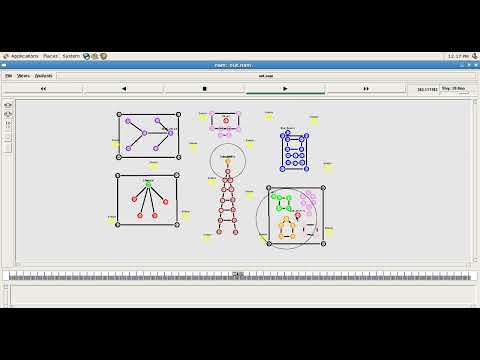
NS2 Simulation
0.0 (0 reviews) • 0 downloads
Low-Power Wide-Area Networks Comparison of LoRaWAN and NB-IoT Performance
र 1000
Low-Power Wide-Area Networks Comparison of LoRaWAN and NB-IoT Performance
Technical Details
Domain : NS2 Simulation
OS : CentOS Linux
Tools : VM Ware Workstation
OS : CentOS Linux
Tools : VM Ware Workstation
Secure Payment
Instant Download
GST Invoice
24/7 Support
About This Product
Low-Power Wide-Area Networks Comparison of LoRaWAN and NB-IoT Performance
Abstract
Low-Power Wide-Area Networks (LPWANs) have become essential for connecting massive numbers of Internet of Things (IoT) devices over long distances with minimal power consumption. Among LPWAN technologies, LoRaWAN and Narrowband IoT (NB-IoT) are two of the most widely adopted standards. While LoRaWAN employs unlicensed sub-GHz bands with adaptive data rates and a lightweight MAC layer, NB-IoT leverages licensed cellular spectrum with enhanced reliability and carrier-grade infrastructure. This paper provides a comparative performance evaluation of LoRaWAN and NB-IoT in terms of coverage, data rate, latency, power efficiency, scalability, security, and cost. By analyzing their strengths and limitations under diverse deployment scenarios, the study guides network designers and operators in selecting the most appropriate technology for smart cities, industrial IoT, and other large-scale applications.
Existing System
Current studies on LPWANs often focus on individual technologies or present high-level comparisons without detailed empirical or simulation-based performance metrics. LoRaWAN, operating in unlicensed bands, offers flexible deployment and cost advantages but suffers from duty-cycle restrictions, susceptibility to interference, and limited QoS guarantees. NB-IoT, built on LTE standards, provides robust connectivity, guaranteed QoS, and seamless integration with existing mobile operator infrastructure but entails higher module costs, SIM management, and dependency on telecom providers. Many existing analyses overlook real-world constraints such as device density, mobility, and heterogeneous traffic patterns, leading to incomplete or biased assessments. Consequently, decision-makers lack a unified framework for evaluating LPWAN performance across multiple parameters.
Proposed System
The proposed work introduces a systematic comparative framework for evaluating LoRaWAN and NB-IoT performance under realistic IoT deployment conditions. Using both simulation and empirical testbeds, key metrics—coverage range, link reliability, throughput, latency, energy consumption, cost per device, and security features—are measured and benchmarked. The framework also considers application-specific requirements, such as low-latency alarms, periodic telemetry, or massive asynchronous sensor deployments. Multi-factor scoring and weighted decision analysis are applied to produce an overall suitability index for different use cases (e.g., smart metering, environmental monitoring, industrial automation). This structured comparison highlights scenarios where LoRaWAN excels (low-cost, large-area sparse deployments) versus NB-IoT (high reliability, licensed spectrum, integration with 4G/5G networks). The resulting guidelines help stakeholders make evidence-based choices when planning large-scale IoT rollouts.
Abstract
Low-Power Wide-Area Networks (LPWANs) have become essential for connecting massive numbers of Internet of Things (IoT) devices over long distances with minimal power consumption. Among LPWAN technologies, LoRaWAN and Narrowband IoT (NB-IoT) are two of the most widely adopted standards. While LoRaWAN employs unlicensed sub-GHz bands with adaptive data rates and a lightweight MAC layer, NB-IoT leverages licensed cellular spectrum with enhanced reliability and carrier-grade infrastructure. This paper provides a comparative performance evaluation of LoRaWAN and NB-IoT in terms of coverage, data rate, latency, power efficiency, scalability, security, and cost. By analyzing their strengths and limitations under diverse deployment scenarios, the study guides network designers and operators in selecting the most appropriate technology for smart cities, industrial IoT, and other large-scale applications.
Existing System
Current studies on LPWANs often focus on individual technologies or present high-level comparisons without detailed empirical or simulation-based performance metrics. LoRaWAN, operating in unlicensed bands, offers flexible deployment and cost advantages but suffers from duty-cycle restrictions, susceptibility to interference, and limited QoS guarantees. NB-IoT, built on LTE standards, provides robust connectivity, guaranteed QoS, and seamless integration with existing mobile operator infrastructure but entails higher module costs, SIM management, and dependency on telecom providers. Many existing analyses overlook real-world constraints such as device density, mobility, and heterogeneous traffic patterns, leading to incomplete or biased assessments. Consequently, decision-makers lack a unified framework for evaluating LPWAN performance across multiple parameters.
Proposed System
The proposed work introduces a systematic comparative framework for evaluating LoRaWAN and NB-IoT performance under realistic IoT deployment conditions. Using both simulation and empirical testbeds, key metrics—coverage range, link reliability, throughput, latency, energy consumption, cost per device, and security features—are measured and benchmarked. The framework also considers application-specific requirements, such as low-latency alarms, periodic telemetry, or massive asynchronous sensor deployments. Multi-factor scoring and weighted decision analysis are applied to produce an overall suitability index for different use cases (e.g., smart metering, environmental monitoring, industrial automation). This structured comparison highlights scenarios where LoRaWAN excels (low-cost, large-area sparse deployments) versus NB-IoT (high reliability, licensed spectrum, integration with 4G/5G networks). The resulting guidelines help stakeholders make evidence-based choices when planning large-scale IoT rollouts.
Customer Reviews (0)
No reviews yet. Be the first!
Related Products
⭐ Featured
NS2 Simulation
W-GeoR Weighted Geographical Routing for VANET's Health Monitoring Applications in Urban Traffic Networks
W-GeoR Weighted Geographical Routing for VANET's Health Monitoring Applications in Urban Traffic Networks
र 1000
⭐ Featured
NS2 Simulation
Reliability-Aware Multi-Objective Optimization-Based Routing Protocol for VANET
Reliability-Aware Multi-Objective Optimization-Based Routing Protocol for VANET
र 1000
⭐ Featured
NS2 Simulation
PSEBVC Provably Secure ECC and Biometric Based Authentication Framework Using Smartphone for Vehicular Cloud Environment
PSEBVC Provably Secure ECC and Biometric Based Authentication Framework Using Smartphone for Vehicular Cloud Environment
र 1000
⭐ Featured
NS2 Simulation
Notice of Removal An Improved Equal Hierarchical Cluster-Based Routing Protocol for EH-WSNs to Enhance Balanced Utilization of Harvested Energy
Notice of Removal An Improved Equal Hierarchical Cluster-Based Routing Protocol for EH-WSNs to Enhance Balanced Utilization of Harvested Energy
र 1000