NS2 Simulation
0.0 (0 reviews) • 0 downloads
An Evolutionary Algorithm-Based Vehicular Clustering Technique for VANETs
र 1000
An Evolutionary Algorithm-Based Vehicular Clustering Technique for VANETs
Technical Details
Domain : NS2 Simulation
OS : CentOS Linux
Tools : VM Ware Workstation
OS : CentOS Linux
Tools : VM Ware Workstation
Secure Payment
Instant Download
GST Invoice
24/7 Support
About This Product
An Evolutionary Algorithm-Based Vehicular Clustering Technique for VANETs
Abstract
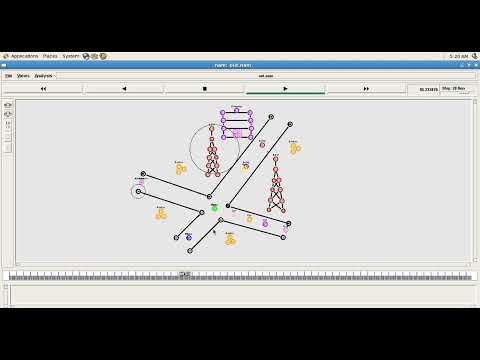
Vehicular Ad Hoc Networks (VANETs) are critical enablers of intelligent transportation systems, providing real-time communication among vehicles and roadside infrastructure. However, high vehicle mobility and dynamic network topologies in urban and highway scenarios make stable and efficient clustering a persistent challenge. This paper presents an evolutionary algorithm-based vehicular clustering technique designed to form and maintain optimal clusters in VANETs. By encoding clustering parameters (e.g., vehicle speed, direction, density, and link quality) into candidate solutions and evolving them through selection, crossover, and mutation operations, the proposed approach converges to stable and well-balanced clusters with minimal control overhead. Comparative analysis shows that the evolutionary approach reduces cluster head changes, improves packet delivery ratio, and lowers end-to-end delay compared to conventional graph-based clustering techniques.
Existing System
Most existing VANET clustering schemes—such as Lowest-ID, Highest-Degree, Mobility-Based or Weighted Clustering algorithms—use static thresholds or greedy heuristics to select cluster heads and assign members. While straightforward, these approaches struggle in high-mobility environments where vehicle speeds, densities, and link qualities fluctuate rapidly. As a result, cluster heads change frequently, clusters disintegrate, and routing performance degrades. Additionally, traditional clustering methods often consider only a subset of parameters (e.g., distance or speed) without multi-objective optimization, leading to unbalanced clusters or excessive signaling overhead. These limitations reduce the stability, scalability, and quality of service (QoS) of VANET communications, especially for safety-critical applications.
Proposed System
The proposed system applies an evolutionary algorithm (EA) to optimize cluster formation and cluster head selection in real time. Each potential clustering configuration is treated as an individual in the EA population, with a fitness function incorporating multiple criteria: vehicle velocity, relative direction, link duration, signal strength, and node degree. Through iterative selection, crossover, and mutation, the EA searches for near-optimal cluster assignments that maximize stability and minimize control overhead. A predictive mechanism based on past mobility patterns helps anticipate topology changes, allowing the algorithm to proactively adjust clusters before they break. Cluster heads are chosen not only for connectivity but also for energy efficiency and communication reliability. This approach reduces re-clustering events, improves packet delivery, and enhances routing performance under varying urban and highway conditions. The technique is compatible with existing VANET routing protocols and can be integrated as a clustering module to support next-generation cooperative driving and infotainment services.
Abstract
Vehicular Ad Hoc Networks (VANETs) are critical enablers of intelligent transportation systems, providing real-time communication among vehicles and roadside infrastructure. However, high vehicle mobility and dynamic network topologies in urban and highway scenarios make stable and efficient clustering a persistent challenge. This paper presents an evolutionary algorithm-based vehicular clustering technique designed to form and maintain optimal clusters in VANETs. By encoding clustering parameters (e.g., vehicle speed, direction, density, and link quality) into candidate solutions and evolving them through selection, crossover, and mutation operations, the proposed approach converges to stable and well-balanced clusters with minimal control overhead. Comparative analysis shows that the evolutionary approach reduces cluster head changes, improves packet delivery ratio, and lowers end-to-end delay compared to conventional graph-based clustering techniques.
Existing System
Most existing VANET clustering schemes—such as Lowest-ID, Highest-Degree, Mobility-Based or Weighted Clustering algorithms—use static thresholds or greedy heuristics to select cluster heads and assign members. While straightforward, these approaches struggle in high-mobility environments where vehicle speeds, densities, and link qualities fluctuate rapidly. As a result, cluster heads change frequently, clusters disintegrate, and routing performance degrades. Additionally, traditional clustering methods often consider only a subset of parameters (e.g., distance or speed) without multi-objective optimization, leading to unbalanced clusters or excessive signaling overhead. These limitations reduce the stability, scalability, and quality of service (QoS) of VANET communications, especially for safety-critical applications.
Proposed System
The proposed system applies an evolutionary algorithm (EA) to optimize cluster formation and cluster head selection in real time. Each potential clustering configuration is treated as an individual in the EA population, with a fitness function incorporating multiple criteria: vehicle velocity, relative direction, link duration, signal strength, and node degree. Through iterative selection, crossover, and mutation, the EA searches for near-optimal cluster assignments that maximize stability and minimize control overhead. A predictive mechanism based on past mobility patterns helps anticipate topology changes, allowing the algorithm to proactively adjust clusters before they break. Cluster heads are chosen not only for connectivity but also for energy efficiency and communication reliability. This approach reduces re-clustering events, improves packet delivery, and enhances routing performance under varying urban and highway conditions. The technique is compatible with existing VANET routing protocols and can be integrated as a clustering module to support next-generation cooperative driving and infotainment services.
Customer Reviews (0)
No reviews yet. Be the first!
Related Products
⭐ Featured
NS2 Simulation
W-GeoR Weighted Geographical Routing for VANET's Health Monitoring Applications in Urban Traffic Networks
W-GeoR Weighted Geographical Routing for VANET's Health Monitoring Applications in Urban Traffic Networks
र 1000
⭐ Featured
NS2 Simulation
Reliability-Aware Multi-Objective Optimization-Based Routing Protocol for VANET
Reliability-Aware Multi-Objective Optimization-Based Routing Protocol for VANET
र 1000
⭐ Featured
NS2 Simulation
PSEBVC Provably Secure ECC and Biometric Based Authentication Framework Using Smartphone for Vehicular Cloud Environment
PSEBVC Provably Secure ECC and Biometric Based Authentication Framework Using Smartphone for Vehicular Cloud Environment
र 1000
⭐ Featured
NS2 Simulation
Notice of Removal An Improved Equal Hierarchical Cluster-Based Routing Protocol for EH-WSNs to Enhance Balanced Utilization of Harvested Energy
Notice of Removal An Improved Equal Hierarchical Cluster-Based Routing Protocol for EH-WSNs to Enhance Balanced Utilization of Harvested Energy
र 1000