Matlab Projects
0.0 (0 reviews) • 0 downloads
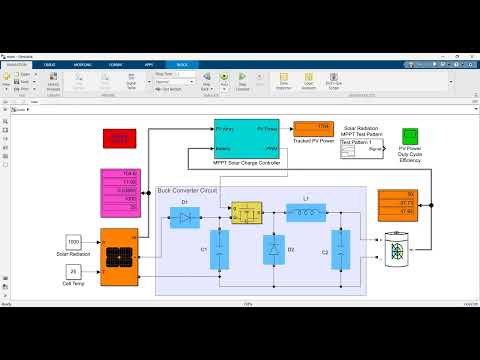
MPPT Solar Charge Controller Model
र 1000
MPPT Solar Charge Controller Model
Technical Details
Domain : MATLAB
Tools : Matlab 2021a
Tools : Matlab 2021a
Secure Payment
Instant Download
GST Invoice
24/7 Support
About This Product
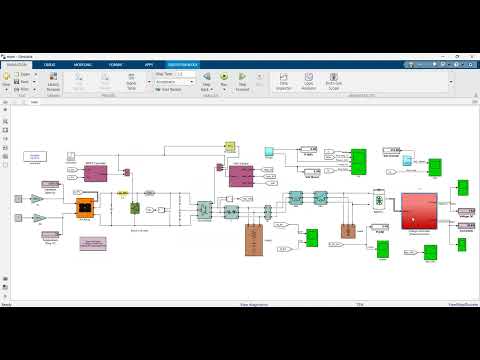
MPPT Solar Charge Controller Model
Abstract
A Maximum Power Point Tracking (MPPT) solar charge controller model maximizes photovoltaic (PV) energy harvest by dynamically tuning the operating point of a PV array while managing battery charging safely and efficiently. This model integrates an MPPT algorithm (e.g., Perturb & Observe, Incremental Conductance, or an adaptive/AI-enhanced method) with a DC–DC power stage and battery-management logic to provide regulated charging profiles, overcharge protection, and load management. By continuously tracking irradiance and temperature-induced changes in the PV I–V curve and adjusting converter duty-cycle or switching strategy, the controller keeps the PV array operating at or near its maximum power point while respecting battery chemistry constraints (CC/CV, temperature compensation). The result is higher system efficiency, longer battery life, and better reliability for grid-tied, off-grid, and hybrid solar applications.
Existing System
Traditional solar charge controllers fall into three broad categories: simple on/off (shunt) controllers, PWM (pulse-width modulation) controllers, and MPPT controllers. Shunt and PWM are inexpensive and straightforward but cannot extract maximum available power under variable irradiance and temperature. Classical MPPT implementations (basic P&O or Incremental Conductance) running on low-cost microcontrollers improve yield but suffer from issues: oscillation around MPP under steady conditions, misdirection under rapidly changing irradiance, tradeoffs between convergence speed and stability (fixed step-size problem), and limited adaptation to partial shading or nonideal PV behavior. Hardware limitations (inefficient converters, poor thermal management) and immature battery-management integration can further reduce system performance and battery lifetime. Additionally, low-cost controllers may lack robust protections (reverse current blocking, temperature compensation, accurate SOC estimation), reducing reliability in long-term deployments.
Proposed System
The proposed MPPT solar charge controller model combines a high-efficiency bidirectional DC–DC stage, an adaptive MPPT algorithm, and an integrated battery-management system (BMS) to form a resilient, high-yield charging platform. Key components and features:
Adaptive MPPT core: an algorithm that blends P&O/IncCond with adaptive step-size, irradiance-change detection, and optional machine-learning (or fuzzy-logic) refinement to reduce oscillations, speed convergence, and resist errors under partial shading or rapid cloud transients.
Power stage: synchronous buck/boost (or buck-only for typical PV-to-battery cases) converter with synchronous rectification for low conduction losses, interlock dead-time control, and thermal-aware switching schedules.
Battery management: CC–CV charging profiles, temperature compensation, SOC/SOH estimation (Coulomb counting + voltage/impedance heuristics), controlled charge/discharge current limits, and state-based actions (float, equalize, discharge protection).
Protection & reliability features: reverse-current blocking, over/under-voltage, over-temperature, short-circuit protection, MPPT failover logic, and logging of performance/alargy events.
System intelligence & communications: local HMI and telemetry (CAN/Modbus/LoRa/Wi-Fi) to report PV, battery, and load metrics; remote firmware updates; and configurable priorities for load shedding or exporting to the grid.
Implementation notes: run the controller on an MCU or DSP with ADC front-end for precise current/voltage sensing, fast inner-current loop and outer-voltage loop control, and interrupt-driven MPPT routine. Use high-quality sensors, low-Rds(on) MOSFETs, and proper EMI/thermal design.
This model yields superior energy harvest (especially under variable conditions), better battery health via intelligent charging, and operational flexibility (hybrid grid/off-grid modes). It is suitable for residential and small commercial PV systems, microgrids, and EV charging interfaces.
Abstract
A Maximum Power Point Tracking (MPPT) solar charge controller model maximizes photovoltaic (PV) energy harvest by dynamically tuning the operating point of a PV array while managing battery charging safely and efficiently. This model integrates an MPPT algorithm (e.g., Perturb & Observe, Incremental Conductance, or an adaptive/AI-enhanced method) with a DC–DC power stage and battery-management logic to provide regulated charging profiles, overcharge protection, and load management. By continuously tracking irradiance and temperature-induced changes in the PV I–V curve and adjusting converter duty-cycle or switching strategy, the controller keeps the PV array operating at or near its maximum power point while respecting battery chemistry constraints (CC/CV, temperature compensation). The result is higher system efficiency, longer battery life, and better reliability for grid-tied, off-grid, and hybrid solar applications.
Existing System
Traditional solar charge controllers fall into three broad categories: simple on/off (shunt) controllers, PWM (pulse-width modulation) controllers, and MPPT controllers. Shunt and PWM are inexpensive and straightforward but cannot extract maximum available power under variable irradiance and temperature. Classical MPPT implementations (basic P&O or Incremental Conductance) running on low-cost microcontrollers improve yield but suffer from issues: oscillation around MPP under steady conditions, misdirection under rapidly changing irradiance, tradeoffs between convergence speed and stability (fixed step-size problem), and limited adaptation to partial shading or nonideal PV behavior. Hardware limitations (inefficient converters, poor thermal management) and immature battery-management integration can further reduce system performance and battery lifetime. Additionally, low-cost controllers may lack robust protections (reverse current blocking, temperature compensation, accurate SOC estimation), reducing reliability in long-term deployments.
Proposed System
The proposed MPPT solar charge controller model combines a high-efficiency bidirectional DC–DC stage, an adaptive MPPT algorithm, and an integrated battery-management system (BMS) to form a resilient, high-yield charging platform. Key components and features:
Adaptive MPPT core: an algorithm that blends P&O/IncCond with adaptive step-size, irradiance-change detection, and optional machine-learning (or fuzzy-logic) refinement to reduce oscillations, speed convergence, and resist errors under partial shading or rapid cloud transients.
Power stage: synchronous buck/boost (or buck-only for typical PV-to-battery cases) converter with synchronous rectification for low conduction losses, interlock dead-time control, and thermal-aware switching schedules.
Battery management: CC–CV charging profiles, temperature compensation, SOC/SOH estimation (Coulomb counting + voltage/impedance heuristics), controlled charge/discharge current limits, and state-based actions (float, equalize, discharge protection).
Protection & reliability features: reverse-current blocking, over/under-voltage, over-temperature, short-circuit protection, MPPT failover logic, and logging of performance/alargy events.
System intelligence & communications: local HMI and telemetry (CAN/Modbus/LoRa/Wi-Fi) to report PV, battery, and load metrics; remote firmware updates; and configurable priorities for load shedding or exporting to the grid.
Implementation notes: run the controller on an MCU or DSP with ADC front-end for precise current/voltage sensing, fast inner-current loop and outer-voltage loop control, and interrupt-driven MPPT routine. Use high-quality sensors, low-Rds(on) MOSFETs, and proper EMI/thermal design.
This model yields superior energy harvest (especially under variable conditions), better battery health via intelligent charging, and operational flexibility (hybrid grid/off-grid modes). It is suitable for residential and small commercial PV systems, microgrids, and EV charging interfaces.
Customer Reviews (0)
No reviews yet. Be the first!
Related Products
⭐ Featured
⭐ Featured
Matlab Projects
Hybrid Photovoltaic and Wind power system
Hybrid Photovoltaic and Wind power system
र 1000
⭐ Featured
Matlab Projects
PV System with optimization algorithms
PV System with optimization algorithms
र 1000