
Matlab Projects
0.0 (0 reviews) • 0 downloads
MPPT Tracking Based on Particle Swarm Optimization
र 1000
MPPT Tracking Based on Particle Swarm Optimization
Technical Details
Domain : MATLAB
Tools : Matlab 2021a
Tools : Matlab 2021a
Secure Payment
Instant Download
GST Invoice
24/7 Support
About This Product
MPPT Tracking Based on Particle Swarm Optimization
Abstract
Maximum Power Point Tracking (MPPT) ensures that photovoltaic (PV) systems operate at their optimal power point despite fluctuating irradiance and temperature. Conventional MPPT methods such as Perturb & Observe (P&O) or Incremental Conductance (IncCond) are simple but may fail under partial shading or rapidly changing conditions. This paper presents an MPPT algorithm based on Particle Swarm Optimization (PSO), a population-based metaheuristic inspired by the social behavior of bird flocks and fish schools. By iteratively searching the PV power–voltage characteristic space using multiple “particles,” the PSO approach converges on the global maximum power point, even in multi-peak scenarios caused by shading. Simulation and experimental results demonstrate faster convergence, higher tracking efficiency, and greater robustness compared with traditional MPPT methods.
Existing System
Traditional MPPT algorithms (P&O, IncCond, hill-climbing) are widely implemented due to their low computational cost, but they typically assume a single, smooth power–voltage curve. Under partial shading or module mismatch, multiple local maxima occur, leading conventional methods to get trapped in a local peak and extract suboptimal power. Fixed step-size approaches also trade off between convergence speed and steady-state oscillation. While some improved algorithms use adaptive step sizes or fuzzy logic, they still rely on local derivative information and lack a true global search capability. As a result, PV systems under complex conditions often fail to operate at their maximum possible power output.
Proposed System
The proposed PSO-based MPPT algorithm treats each potential operating point (voltage or duty cycle) as a “particle” in a search space. Each particle adjusts its position according to its own best-known position and the swarm’s global best position, effectively exploring the PV curve for the global maximum power point. Key features of the proposed system:
Global Search Capability: can locate the true MPP even under partial shading with multiple peaks.
Adaptive Convergence: dynamically adjusts particle velocities to balance exploration and exploitation.
Fast Response: fewer iterations to reach the global MPP compared with other metaheuristics.
Implementation Flexibility: can run on mid-range microcontrollers or DSPs due to low memory footprint.
Hybrid Control: PSO can be combined with a fine-tuned local MPPT (e.g., IncCond) for ultra-fast final convergence and minimal oscillation.
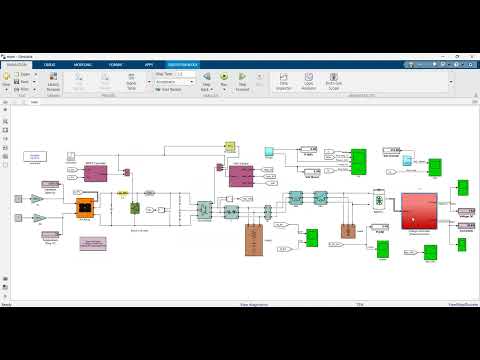
In practice, the PSO-based MPPT controls the duty cycle of a DC–DC converter (buck, boost, or buck-boost), measuring PV voltage and current to compute instantaneous power at each iteration. This approach increases PV system efficiency, particularly in shaded or rapidly changing conditions, and extends the economic value of solar installations.
Abstract
Maximum Power Point Tracking (MPPT) ensures that photovoltaic (PV) systems operate at their optimal power point despite fluctuating irradiance and temperature. Conventional MPPT methods such as Perturb & Observe (P&O) or Incremental Conductance (IncCond) are simple but may fail under partial shading or rapidly changing conditions. This paper presents an MPPT algorithm based on Particle Swarm Optimization (PSO), a population-based metaheuristic inspired by the social behavior of bird flocks and fish schools. By iteratively searching the PV power–voltage characteristic space using multiple “particles,” the PSO approach converges on the global maximum power point, even in multi-peak scenarios caused by shading. Simulation and experimental results demonstrate faster convergence, higher tracking efficiency, and greater robustness compared with traditional MPPT methods.
Existing System
Traditional MPPT algorithms (P&O, IncCond, hill-climbing) are widely implemented due to their low computational cost, but they typically assume a single, smooth power–voltage curve. Under partial shading or module mismatch, multiple local maxima occur, leading conventional methods to get trapped in a local peak and extract suboptimal power. Fixed step-size approaches also trade off between convergence speed and steady-state oscillation. While some improved algorithms use adaptive step sizes or fuzzy logic, they still rely on local derivative information and lack a true global search capability. As a result, PV systems under complex conditions often fail to operate at their maximum possible power output.
Proposed System
The proposed PSO-based MPPT algorithm treats each potential operating point (voltage or duty cycle) as a “particle” in a search space. Each particle adjusts its position according to its own best-known position and the swarm’s global best position, effectively exploring the PV curve for the global maximum power point. Key features of the proposed system:
Global Search Capability: can locate the true MPP even under partial shading with multiple peaks.
Adaptive Convergence: dynamically adjusts particle velocities to balance exploration and exploitation.
Fast Response: fewer iterations to reach the global MPP compared with other metaheuristics.
Implementation Flexibility: can run on mid-range microcontrollers or DSPs due to low memory footprint.
Hybrid Control: PSO can be combined with a fine-tuned local MPPT (e.g., IncCond) for ultra-fast final convergence and minimal oscillation.
In practice, the PSO-based MPPT controls the duty cycle of a DC–DC converter (buck, boost, or buck-boost), measuring PV voltage and current to compute instantaneous power at each iteration. This approach increases PV system efficiency, particularly in shaded or rapidly changing conditions, and extends the economic value of solar installations.
Customer Reviews (0)
No reviews yet. Be the first!
Related Products
⭐ Featured


⭐ Featured

Matlab Projects
Hybrid Photovoltaic and Wind power system
Hybrid Photovoltaic and Wind power system
र 1000
⭐ Featured
Matlab Projects
PV System with optimization algorithms
PV System with optimization algorithms
र 1000