Matlab Projects
0.0 (0 reviews) • 0 downloads
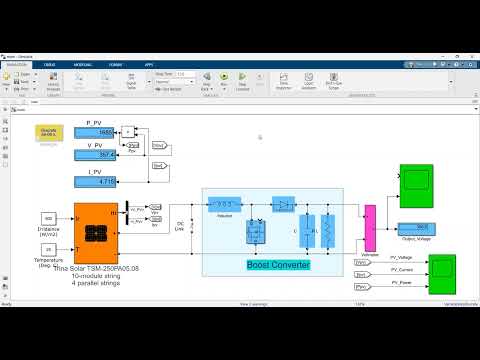
Perturb and Observe MPPT
र 1000
Perturb and Observe MPPT
Technical Details
Domain : MATLAB
Tools : Matlab 2021a
Tools : Matlab 2021a
Secure Payment
Instant Download
GST Invoice
24/7 Support
About This Product
Perturb and Observe MPPT
Abstract
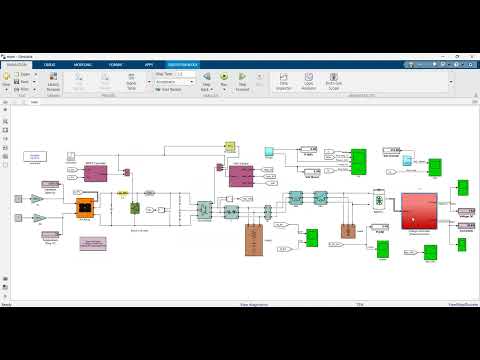
Maximum Power Point Tracking (MPPT) is a core technique in photovoltaic (PV) systems to maximize power extraction under varying environmental conditions. Among the several MPPT algorithms, the Perturb and Observe (P&O) method remains one of the most widely used due to its simplicity, low computational requirements, and ease of implementation. P&O works by periodically perturbing the operating voltage or duty cycle of the PV converter and observing the resulting change in output power. If the power increases, the perturbation continues in the same direction; if it decreases, the direction is reversed. This paper discusses the principles, performance characteristics, and improvements to the conventional P&O MPPT algorithm, emphasizing its application in grid-tied and standalone solar power systems.
Existing System
Traditional P&O MPPT algorithms are easy to implement using low-cost microcontrollers but exhibit drawbacks under rapidly changing irradiance conditions. Standard P&O assumes a quasi-steady state and may misinterpret irradiance-induced power changes as responses to perturbations, leading to oscillations around the maximum power point (MPP) and reduced tracking efficiency. Furthermore, fixed perturbation step sizes can either cause slow convergence (if too small) or large power losses (if too big). These limitations reduce the overall efficiency of PV systems, especially in dynamic weather conditions.
Proposed System
The proposed system enhances the classical P&O MPPT by introducing an adaptive step-size mechanism and predictive decision logic. Instead of using a fixed perturbation step, the algorithm dynamically adjusts the step size based on the slope of the power–voltage curve and the rate of change of irradiance, allowing faster convergence and reduced oscillations. Additionally, a filtering mechanism distinguishes between power changes due to perturbations and those caused by environmental fluctuations, minimizing false direction reversals. The improved P&O can be implemented on low-cost digital controllers or DSPs and provides higher efficiency under rapidly changing conditions compared to the conventional P&O approach.
Abstract
Maximum Power Point Tracking (MPPT) is a core technique in photovoltaic (PV) systems to maximize power extraction under varying environmental conditions. Among the several MPPT algorithms, the Perturb and Observe (P&O) method remains one of the most widely used due to its simplicity, low computational requirements, and ease of implementation. P&O works by periodically perturbing the operating voltage or duty cycle of the PV converter and observing the resulting change in output power. If the power increases, the perturbation continues in the same direction; if it decreases, the direction is reversed. This paper discusses the principles, performance characteristics, and improvements to the conventional P&O MPPT algorithm, emphasizing its application in grid-tied and standalone solar power systems.
Existing System
Traditional P&O MPPT algorithms are easy to implement using low-cost microcontrollers but exhibit drawbacks under rapidly changing irradiance conditions. Standard P&O assumes a quasi-steady state and may misinterpret irradiance-induced power changes as responses to perturbations, leading to oscillations around the maximum power point (MPP) and reduced tracking efficiency. Furthermore, fixed perturbation step sizes can either cause slow convergence (if too small) or large power losses (if too big). These limitations reduce the overall efficiency of PV systems, especially in dynamic weather conditions.
Proposed System
The proposed system enhances the classical P&O MPPT by introducing an adaptive step-size mechanism and predictive decision logic. Instead of using a fixed perturbation step, the algorithm dynamically adjusts the step size based on the slope of the power–voltage curve and the rate of change of irradiance, allowing faster convergence and reduced oscillations. Additionally, a filtering mechanism distinguishes between power changes due to perturbations and those caused by environmental fluctuations, minimizing false direction reversals. The improved P&O can be implemented on low-cost digital controllers or DSPs and provides higher efficiency under rapidly changing conditions compared to the conventional P&O approach.
Customer Reviews (0)
No reviews yet. Be the first!
Related Products
⭐ Featured
⭐ Featured
Matlab Projects
Hybrid Photovoltaic and Wind power system
Hybrid Photovoltaic and Wind power system
र 1000
⭐ Featured
Matlab Projects
PV System with optimization algorithms
PV System with optimization algorithms
र 1000